 d04e821ceb
This adds an experimental code path that I will use to test a docker-only execution mode for server-side batch changes. This code path is never executed for customers until we make the switch when we deem it ready. This will allow me to dogfood this while it's not available to customer instances yet. Ultimately, the goal of this is to make executors simply be "the job runner platform through a generic interface". Today, this depends on src-cli to do a good bunch of the work. This is a blocker for going full docker-based with executors, which will ultimately be a requirement on the road to k8s-based executors. As this removes the dependency on src-cli, nothing but the job interface and API endpoints tie executor and Sourcegraph instance together. Ultimately, this will allow us to support larger version spans between the two (pending executors going GA and being feature-complete). Known issues/limitations: Steps skipped in between steps that run don't work yet Skipping steps dynamically is inefficient as we cannot tell the executor to skip a step IF X, so we replace the script by exit 0 It is unclear if all variants of file mounts still work. Basic cases do work. Files used to be read-only in src-cli, they aren't now, but content is still reset in between steps. The assumption that everything operates in /work is broken here, because we need to use what executors give us to persist out-of-repo state in between containers (like the step result from the previous step) It is unclear if workspace mounts work Cache keys are not correctly computed if using workspace mounts - the metadataretriever is nil We still use log outputs to transfer the AfterStepResults to the Sourcegraph instance, this should finally become an artifact instead. Then, we don't have to rely on the execution_log_entires anymore and can theoretically prune those after some time. This column is currently growing indefinitely. It depends on tee being available in the docker images to capture the cmd.stdout/cmd.stderr properly for template variable rendering Env-vars are not rendered in their evaluated form post-execution File permissions are unclear and might be similarly broken to how they are now - or even worse Disclaimer: It's not feature complete today! But it is also not hitting any default code paths either. As development on this goes on, we can eventually remove the feature flag and run the new job format on all instances. This PR handles fallback of rendering old records correctly in the UI already. |
||
|---|---|---|
| .buildkite | ||
| .github | ||
| .vscode | ||
| .yarn | ||
| client | ||
| cmd | ||
| dev | ||
| doc | ||
| docker-images | ||
| enterprise | ||
| internal | ||
| lib | ||
| migrations | ||
| monitoring | ||
| schema | ||
| third-party-licenses | ||
| ui/assets | ||
| .browserslistrc | ||
| .dockerignore | ||
| .editorconfig | ||
| .eslintignore | ||
| .eslintrc.js | ||
| .gitattributes | ||
| .gitignore | ||
| .golangci.yml | ||
| .graphqlrc.yml | ||
| .hadolint.yaml | ||
| .mailmap | ||
| .mocharc.js | ||
| .percy.yml | ||
| .prettierignore | ||
| .stylelintignore | ||
| .stylelintrc.json | ||
| .tool-versions | ||
| .trivyignore | ||
| .yarnrc.yml | ||
| babel.config.js | ||
| CHANGELOG.md | ||
| CODENOTIFY | ||
| CONTRIBUTING.md | ||
| doc.go | ||
| flake.lock | ||
| flake.nix | ||
| gen.go | ||
| go.mod | ||
| go.sum | ||
| graphql-schema-linter.config.js | ||
| gulpfile.js | ||
| jest.config.base.js | ||
| jest.config.js | ||
| LICENSE | ||
| LICENSE.apache | ||
| LICENSE.enterprise | ||
| lighthouserc.js | ||
| mockgen.temp.yaml | ||
| mockgen.test.yaml | ||
| mockgen.yaml | ||
| package.json | ||
| postcss.config.js | ||
| prettier.config.js | ||
| README.md | ||
| renovate.json | ||
| SECURITY.md | ||
| sg.config.yaml | ||
| shell.nix | ||
| svgo.config.js | ||
| tsconfig.all.json | ||
| tsconfig.eslint.json | ||
| tsconfig.json | ||
| yarn.lock | ||

Docs •
Contributing •
Twitter





Understand, fix, and automate across your codebase with Sourcegraph's code intelligence platform
4.0 Features
🧠 Code intelligence: uplevel your code search
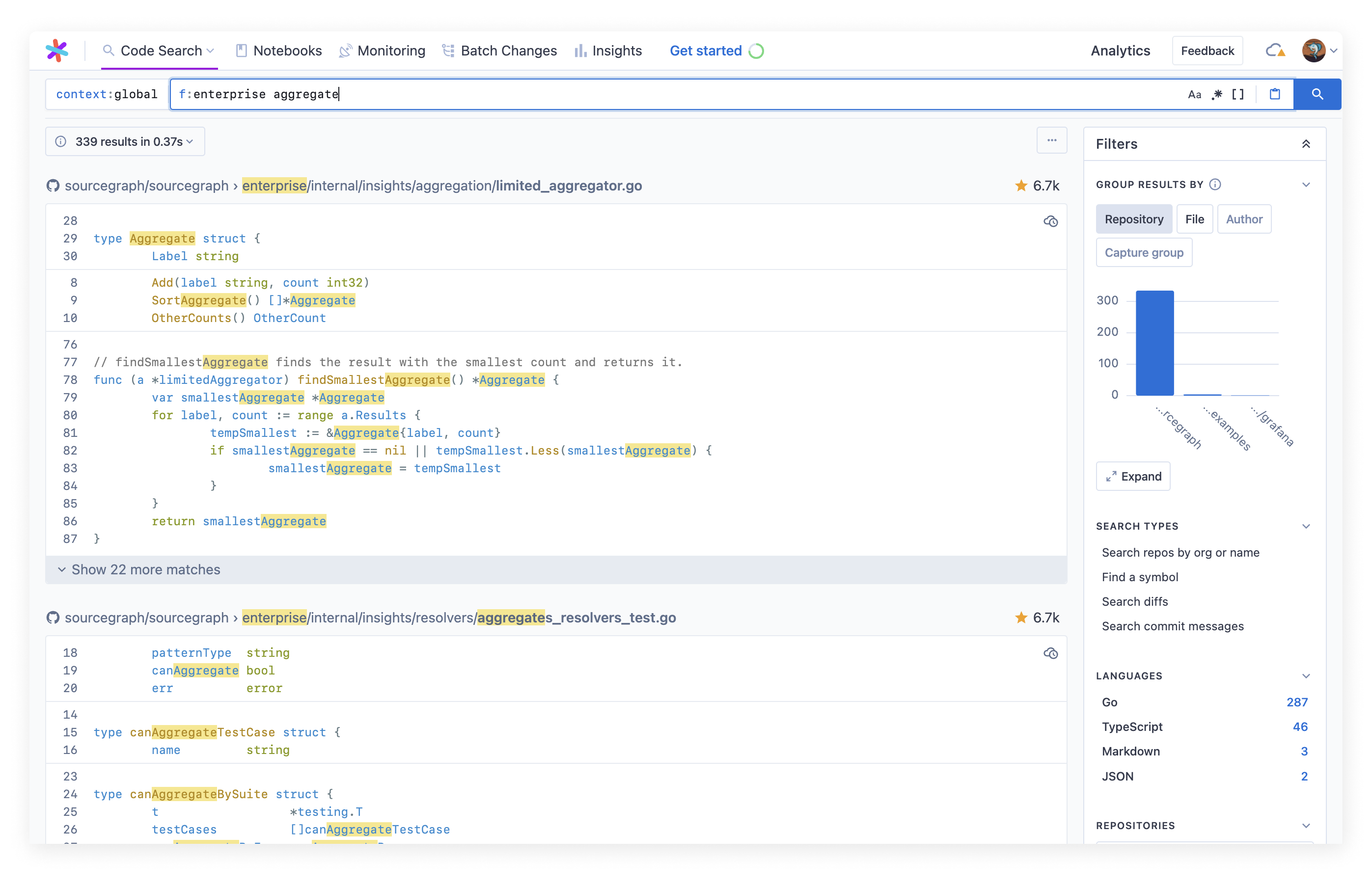
- Understand usage and search structure with high-level aggregations of search results
- A faster, simpler search experience
- Configure precise code navigation for 9 languages (Ruby, Rust, Go, Java, Scala, Kotlin, Python, TypeScript, JavaScript) in a matter of minutes with auto-indexing
- Your favorite extensions are now available by default
- Quickly access answers within your codebase with a revamped reference panel
🏗️ High-leverage ways to improve your entire codebase
- Make changes across all of your codebase at enterprise scale with server-side Batch Changes (beta)
- Run large-scale or resource-intensive batch changes without clogging your local machine
- Run large batch changes quickly by distributing them across an autoscaled pool of compute instances
- Get a better debugging experience with the streaming of logs directly into Sourcegraph.
☁️ Dedicated Sourcegraph Cloud instances for enterprise
- Sourcegraph Cloud now offers dedicated, single-tenant instances of Sourcegraph
📈 Advanced admin capabilities
- Save time upgrading to Sourcegraph 4.0 with multi-version upgrades
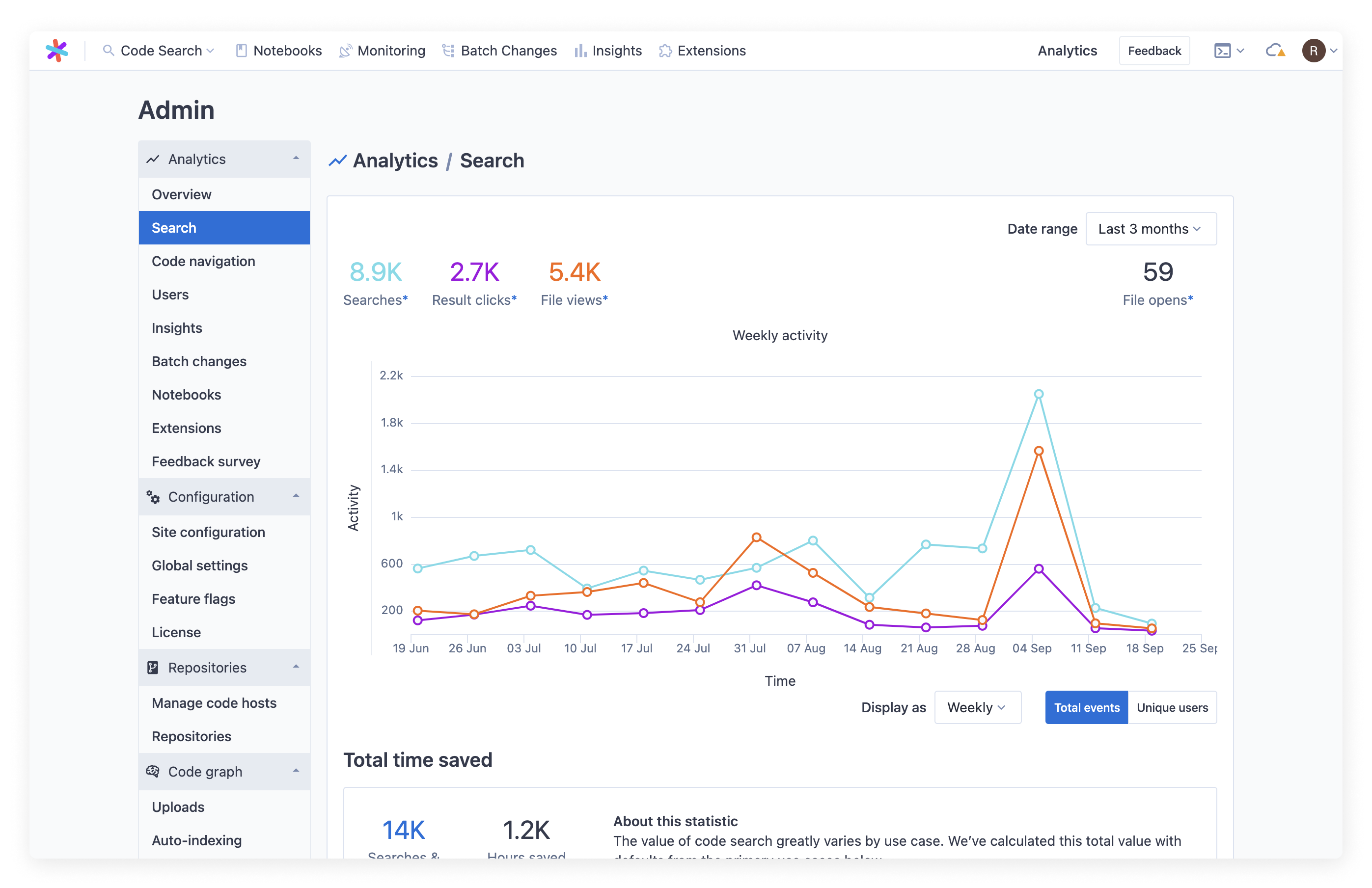
- View usage and measure the value of our platform with new and enhanced in-product analytics
- Uncover developer time saved using Browser and IDE extensions
- Easily export traces using OpenTelemetry
- Quickly see the status on your repository and permissions syncing
- Measure precise code navigation coverage with an enhanced analytics dashboard
Deploy Sourcegraph
Recommended
- Sourcegraph Cloud: create a single-tenant instance managed by Sourcegraph
Self-hosted
Local machine
Development
Refer to the Developing Sourcegraph guide to get started.
Documentation
The doc directory has additional documentation for developing and understanding Sourcegraph:
- Project FAQ
- Architecture: high-level architecture
- Database setup: database best practices
- Go style guide
- Documentation style guide
- GraphQL API: useful tips when modifying the GraphQL API
- Contributing
License
This repository contains both OSS-licensed and non-OSS-licensed files. We maintain one repository rather than two separate repositories mainly for development convenience.
All files in the enterprise and client/web/src/enterprise fall under LICENSE.enterprise.
The remaining files fall under the Apache 2 license. Sourcegraph OSS is built only from the Apache-licensed files in this repository.